In April 2014, Italian Gibran scholar Francesco Medici made a remarkable archival discovery: a rare photograph of Kahlil Gibran, long hidden in a private collection at the Smithsonian Institution — overlooked for decades due to a misspelling of Gibran's name on the catalogue record.
By Glen Kalem-Habib · Kahlil Gibran Collective · 22 April 2014
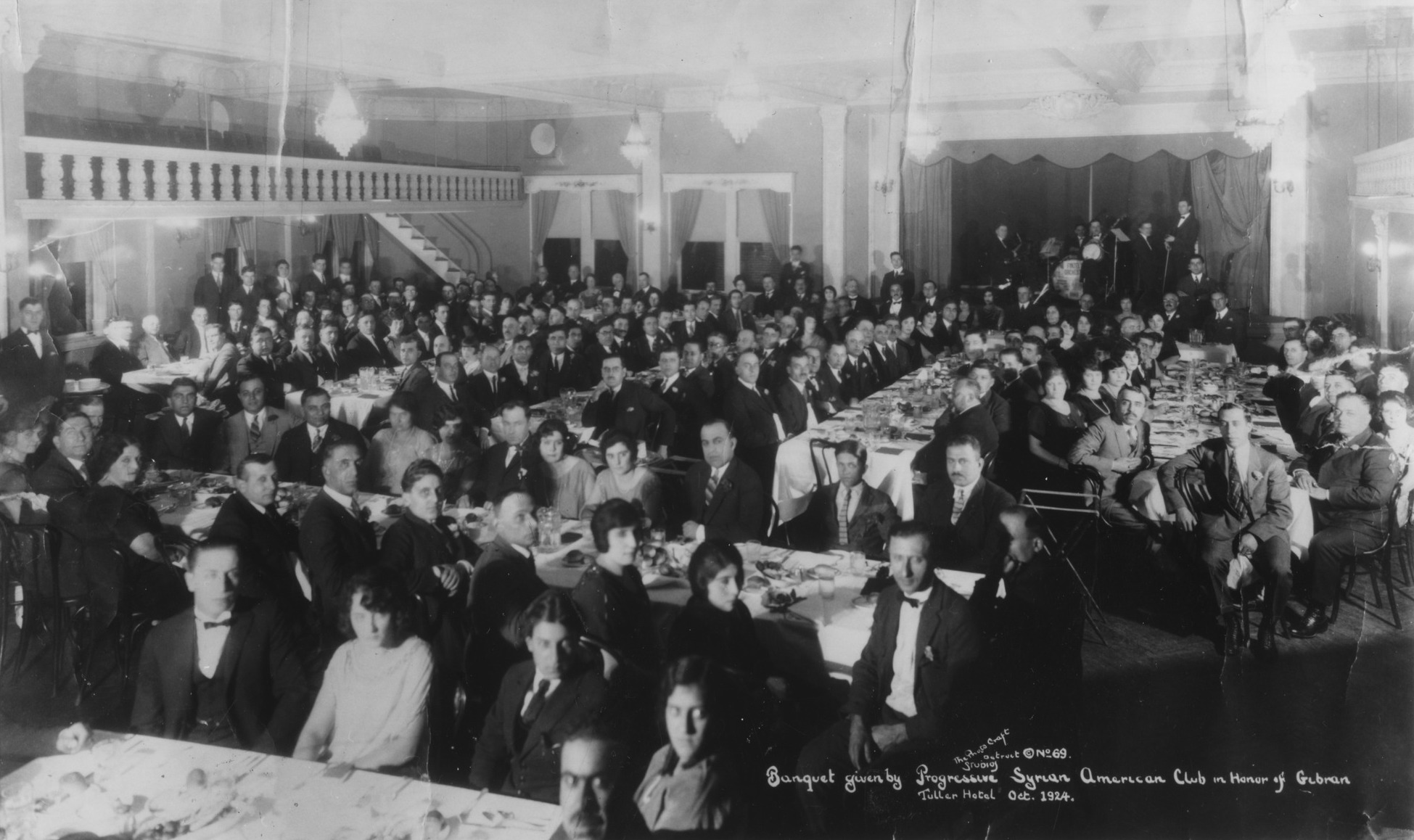
Banquet given by the Progressive Syrian American Club in honour of Kahlil Gibran, October 1924.
Silver gelatin print, 5.8″ × 9.6″. Craft Studios.
Faris and Yamna Naff Arab-American Collection, Archives Center, National Museum of American History, Smithsonian Institution.
It is one of the quiet ironies of archival research that a single clerical error can conceal a discovery for decades. So it was with this photograph: a silver gelatin print measuring 5.8 by 9.6 inches, catalogued under the name "Giran" — a misspelling of Gibran's surname that had effectively placed it beyond the reach of every researcher who had come looking for it.
The photograph was unearthed in 2014 by Francesco Medici — Italian scholar, translator, and research producer on the documentary film Kahlil Gibran: The Reluctant Visionary — during a survey of private collections held at the National Museum of American History, Smithsonian Institution. Medici, who had translated several of Gibran's works into Italian including The Prophet, Lazarus and His Beloved, and The Blind, recognised the significance of the find immediately.
The photograph, taken by the Craft Studios in October 1924, documents an evening hosted by the Progressive Syrian American Club — a banquet held in Gibran's honour, in recognition of his contributions to both the Syrian-American community and to literature. The scene is a large, handsome room at the Tuller Hotel: men and women seated at banquet tables, a small band on stage at the far end of the room, and Gibran himself visible just to the left of the stage.
By October 1924, Gibran had been living in his Greenwich Village studio — which he called The Hermitage — for over a decade, and The Prophet had been published the previous year to quiet but growing acclaim. The banquet captures him at a pivotal moment: a poet and artist still largely unknown to the wider world, but already deeply cherished within the Arab-American community that had supported and sustained him.
The photograph is held as part of the Faris and Yamna Naff Arab-American Collection, Archives Center, National Museum of American History, Smithsonian Institution, Washington D.C.
All Rights Reserved © Copyright Kahlil Gibran Collective 2014