In November 2013, Glen Kalem-Habib travelled from Sydney to Beijing to attend Peking University's annual Middle Eastern Literature conference — marking the first visit to China by any Western Gibran scholar. This is his account of Gibran's deep and enduring presence in Chinese literary culture.
By Glen Kalem-Habib · Kahlil Gibran Collective · 22 April 2014
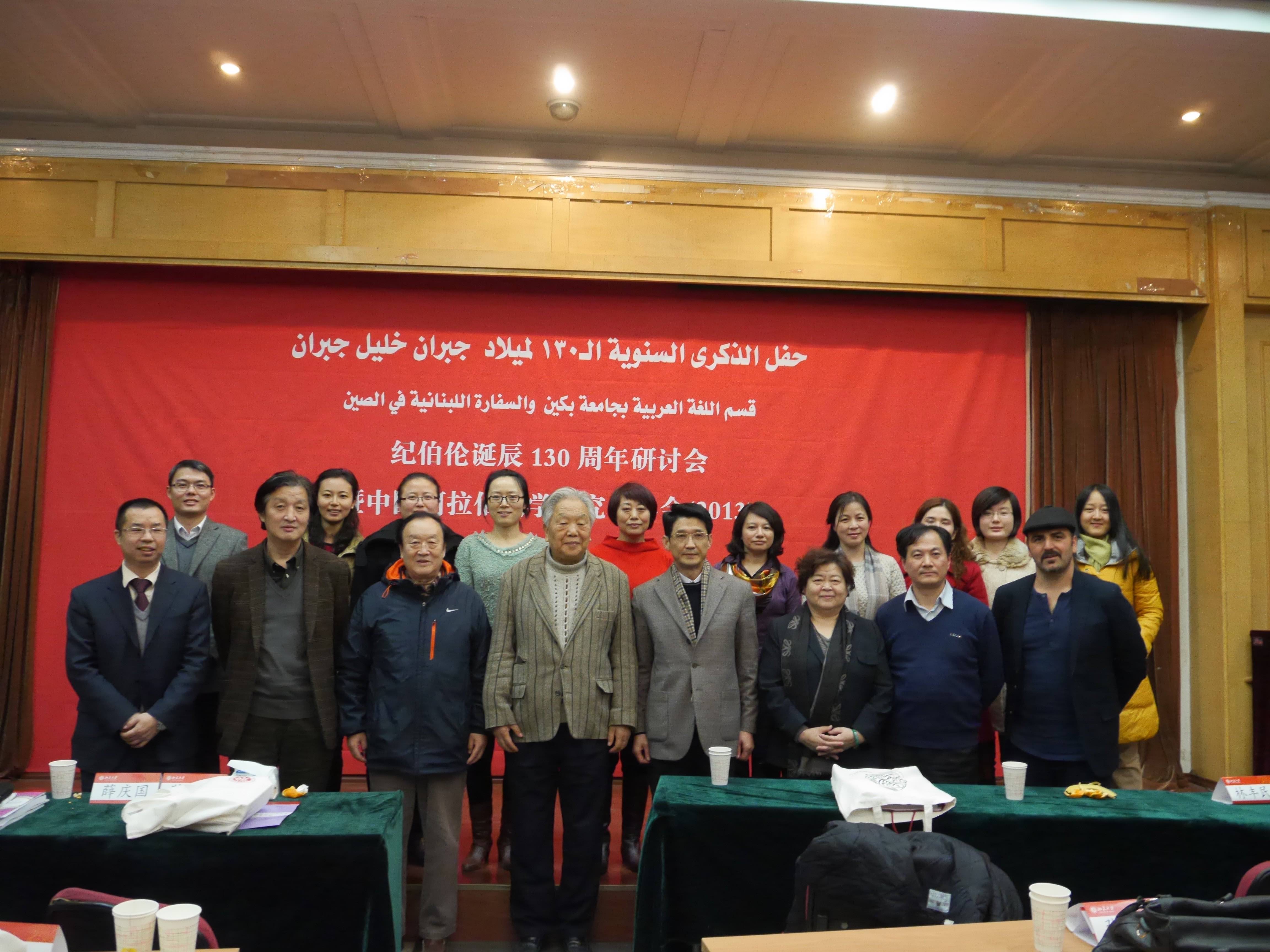
Glen Kalem-Habib (right) in attendance at the Middle Eastern Literature Conference, Peking University, 24 November 2013.
On 24 November 2013, as part of their annual Middle Eastern Literature conference, Peking University celebrated the 130th anniversary of Kahlil Gibran's birth by bringing together academics from across China. Glen Kalem-Habib, an executive member of the newly-founded Kahlil Gibran Global Forum, made the journey from Sydney, Australia, to be part of this celebrated event.
The visit marked the first ever made to China by any Western scholar of Gibran — an occasion that carried both symbolic and scholarly significance. Its aim was to bridge the cultural and academic gap that had existed since the earliest Chinese translations of Gibran's work in the 1920s, and to foster an ongoing dialogue between Gibran scholars of China and the West, where the majority of research and biography had been concentrated over the preceding nine decades.
Peking University is the academic and spiritual home of Gibran in China. Its connection to his work stretches back a full century: the University oversaw some of the earliest Chinese translations of his poetry, carried out by artists and academics who had already recognised in Gibran a voice that spoke across cultural divides. Remarkably, Gibran's poetry holds a singular place in Chinese literary history — it ranks as only the second body of Arabic literature ever to be officially translated into Chinese, after One Thousand and One Nights, first rendered into Chinese in the 1890s.
The first to translate a selection of Gibran's works into Chinese was the celebrated novelist Mao Dun (also known by his given name Shen Yanbing, or pen name Shen Dehong), who completed his translations in 1923. It was not, however, until 1931 that Professor Bing Xin's landmark translation of The Prophet was completed and published — a version that remains widely read in China to this day.
In China today there exists a healthy and growing appetite for Gibran's poetry and history, with numerous works published both online and in print. Conference director Professor Lin Fengmin, PhD, head of the Department of Arabic Language and Literature at Peking University, spoke of the depth of this interest: "There is a large and growing interest in Gibran literature in China," he said, anticipating that the reach of the internet would only deepen it further. "I am confident that if they were to read one sentence of Gibran's poetry, they'll read much more, if not everything."
Also present was Associate Professor Ma Zheng, PhD, of Henan University, then undertaking a sponsored research initiative at the University of Maryland — translating selected works of Kahlil Gibran under the guidance of the late Professor Suheil Bushrui, Research Professor Emeritus, founder of the Kahlil Gibran Global Forum, and director of the George and Lisa Zakhem Kahlil Gibran Chair for Values and Peace.
Glen Kalem-Habib is an international Kahlil Gibran researcher and historian whose years of archival fieldwork have taken him from Sydney to Beirut, New York, and beyond. His research formed the foundation of the feature-length documentary film Kahlil Gibran: The Reluctant Visionary, and he continues his work today as a founding member of the Kahlil Gibran Collective.
All Rights Reserved © Copyright Kahlil Gibran Collective 2014